
Values match
Stand out for more than your CV
A CV shows what you have done. It says far less about what matters to you at work, the environment in which you thrive, and whether your values align with what an employer offers. And that matters because the right company depends on what matters to you.
If you value stability and employee experience, an established organisation may suit you better. If you value growth, responsibility and the chance to build something, a fast‑moving start‑up may make more sense. Neither is inherently better; the question is which environment fits where you are now. This is also why My Values Match suits passive candidates. Even if you are not actively looking, you can explore an opportunity without being labelled or scored permanently.
Recruiters and candidates increasingly face large volumes of applications. More filtering is the usual response, but something important gets lost when recruitment becomes only about CVs, skills and keywords.
The soft side matters too. My Values Match brings it forward.
It all begins when you apply
When you apply through ferdge, you answer four question pairs. One closed, one open. They reveal what you value and why, forming your initial match potential with the employer’s Core Values. Once shortlisted, you answer six additional pairs. Together, the ten pairs create a fuller picture of how your professional values relate to the company’s.
Your My Values Match score applies only to that specific job. It does not follow you from employer to employer. A match is a relationship between you, a role, and an organisation.

Two sides of the match and without AI
Both sides contribute their part: the employer defines its Core Values and how they matter for the role, and you express what matters to you through your answers. The comparison is deterministic, not AI‑driven.
No personality profiling, no automated verdict, no model deciding whether you are a good candidate. The goal is simply to show where your values and the employer’s values meet — creating better evidence for a conversation, not replacing human judgement.
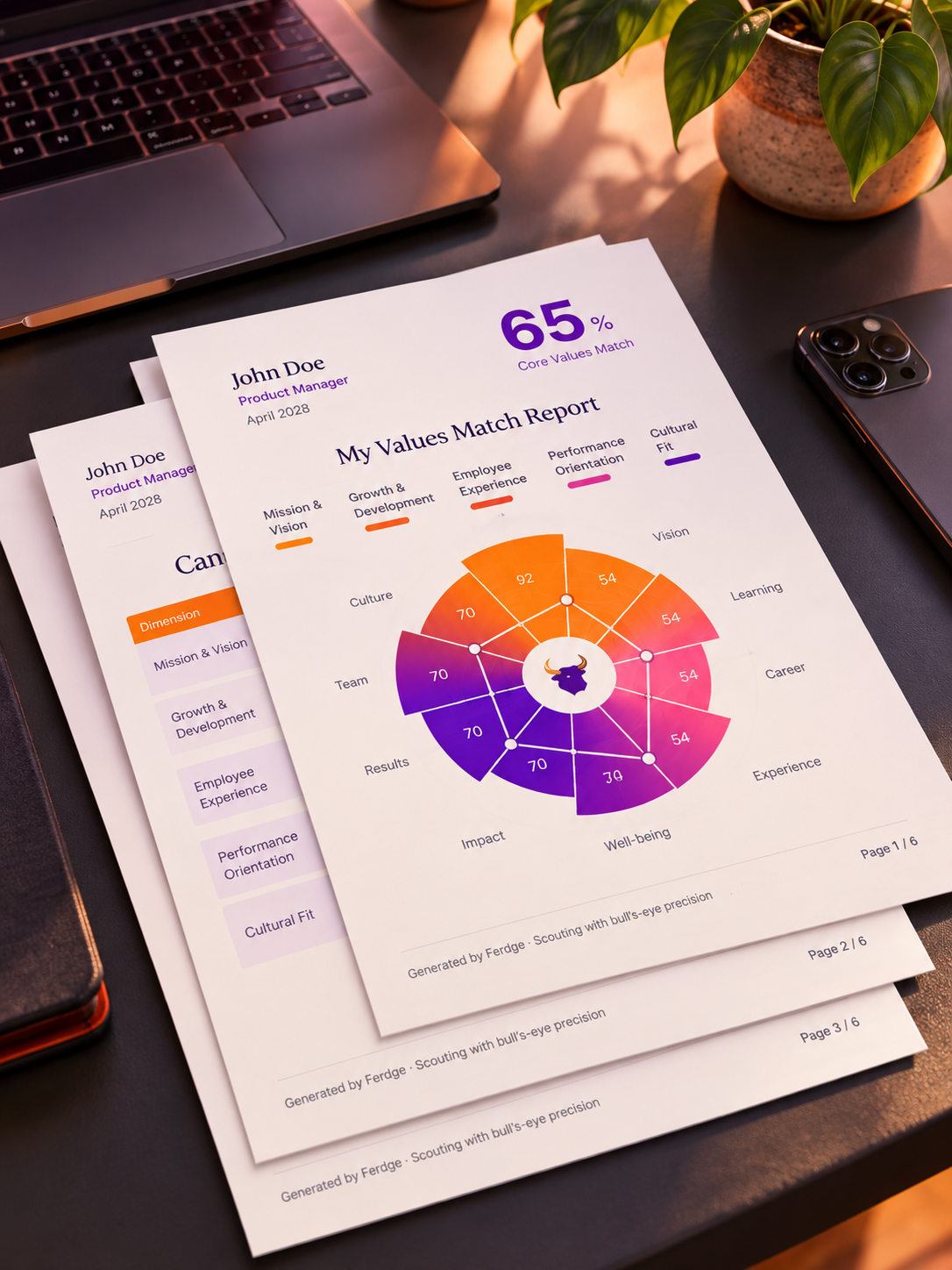
A better match starts a stronger conversation and brings you closer
Twenty applicants may have similar experience. My Values Match adds something their CVs cannot: an indication of which candidates align particularly well with what the employer values. Your My Values Match results become part of how candidates are compared.
A stronger match can place you higher in the ranking, giving recruiters a reason to look beyond familiar CV signals. You see your results on your dashboard and in more detail on your Outcome page.
If one outcome is unexpectedly low, you have one chance per recruitment procedure to refine it within 24 hours — not to manufacture a score, but to ensure your answer reflects what you meant.
Your results remain tied to the individual application. Keeping them current helps, because what matters to you can change, and every employer brings a different side of the equation.
Once you reach the interview stage, My Values Match becomes even more valuable. Instead of revisiting your CV, you and the recruiter can explore what motivates you, what you expect from work, and where your values meet theirs. This is where the soft side of recruitment becomes visible.
Hard evidence like titles, experience, qualifications, matters. But thriving somewhere depends on more than matching a job description. It depends on the organisation’s ambitions, expectations, working environment and values.
A lower score in one area can highlight something worth discussing.
A high score is not a hiring verdict. Skills, experience, interviews and human judgement still matter.
My Values Match adds another piece of evidence. It does not make the decision.
Ready to Take the Next Step in Your Career?